
Smith & Wesson Model 19 Classic “Combat Magnum” | Review

Nineteen-fifty-five was a banner year, for sure, in the gun world. That was the year that retired Assistant Chief Patrol Inspector of the U.S. Border Patrol Bill Jordan approached S&W with the idea of producing a lighter, smaller, K-frame 4-inch .357 Magnum revolver that wouldn’t tire law enforcement personnel out after carrying it all day. He described it as a “Peace Officer’s Dream”. Before, the only .357 Magnum revolvers made by S&W were built on the large “N” frame. The original Registered Magnum and its derivative Model 27 were large, heavy beasts that weighed enough to tire a LEO out after a long shift. Jordan came up wth the idea of something that wouldn’t do that. He was a popular member of the gun writers’ club at that time, and had a stellar record with the Border Patrol, so S&W paid attention.
On November 15, 1955, they presented him with the very first Combat Magnum (which would be renamed the Model 19 in 1957 when S&W gave numbers, not names, to their guns). It’s interesting that the Model 19 was standard issue for uniformed officers of the former U.S. Immigration and Naturalization Service, and Patrol Agents of the U.S. Border Patrol, until it was replaced by the .40 S&W. This is a revolver with a long and storied past.
Smith & Wesson Model 19 Classic .357 Magnum Revolver

My own connection with the Combat Magnum began around 1979 when I was a newly-minted band director in a small west-central Indiana town. I had recently gotten into shooting, reloading, and bullet casting, and was in a gun shop nearby when I saw the first Model 19 I’d seen in a gun case. I still remember that blued beauty sitting there, calling for me to take it home… Alas, on my tiny salary, that couldn’t happen. But, as I said, I still remember it and can picture it in my mind.
When I found out that S&W had released three no-lock (hurray!) versions of what they called Classics (the models 10, 19, and 36), I requested a 19 and a 36. Nothing against the 10, it’s just that the other two have always been special to me. I got the 19 in, and am waiting on the 36.
Specifications
- Width: 1.45 In
- Length: 9.87 In
- Height: 5.85 In
- Weight: 37.4 Oz
- Caliber: 357 Magnum
- Size: Medium (K-Frame)
- Capacity: 6
- Action: Single/Double Action
- Barrel Length: 4.25
- Grip: Wood
- Sights: Red Ramp, Adjustable Rear
- Optic Ready: No
- Safety: None
- Color/Finish: Blued
- State Compliance: CO, CT, DE, HI, IL, MD, NJ, NY, RI, VT, WA
- Threaded Barrel: No
- Barrel Material: Carbon Steel
- Frame: Carbon Steel
Differences, Old And New
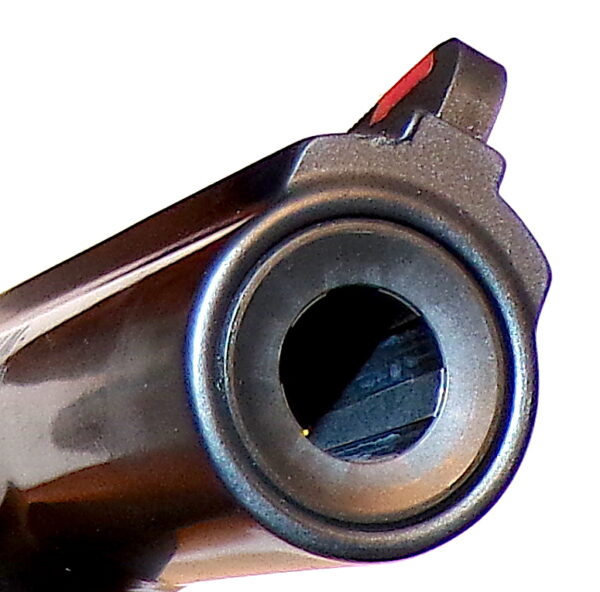
According to other shooters I’ve talked to about this gun, this is a downside. Several of them remember when S&W used a one-piece barrel, machined and screwed into place, and long for those guns to be back. The reason they went with a two-piece version here, according to my research, is that the original barrels had a tendency to split. I have never seen this, but evidently it has happened. The two-piecer solves that problem. So, yup, it ain’t like the ones of old, but it still works.
OK. So, Why Is This Wheelgun Special?
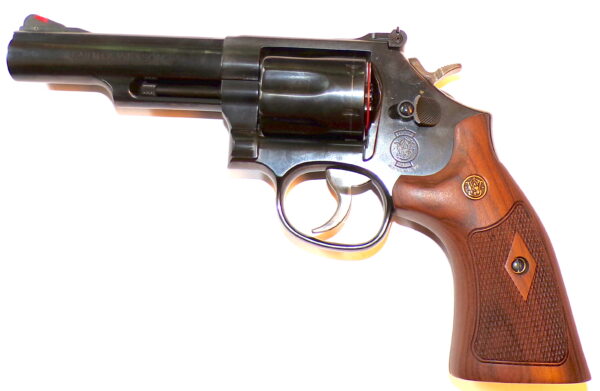

This was the first .357 that wouldn’t drag your gun belt down after a long day. It had a 4-inch barrel (but was eventually made with shorter and longer tubes), and it had a nice adjustable rear sight coupled with a red-insert front sight.


Shooting the Smith & Wesson 19 Combat Magnum

I enlisted the help of my good friend Ed, a former deputy. He was interested in this revolver, although he is more familiar with semi-autos. He wanted to give it a go, so we did. We shot some .38 Special and .357 Magnum ammo that I had. We set some paper up at 25 yards in my backyard and let fly.
This shooting session was strictly a formality… I had no qualms about this gun’s ability to stack holes in paper pretty close together. I own an 8 ⅜” Model 629 .44 Magnum that will shoot the nuts off a gnat, and I’ve owned many other S&W wheelguns that would do the same, so I wasn’t concerned about accuracy. This is not designed as a bullseye gun, but for day-to-day use, it will do.
At any rate, here are a few targets we kept…

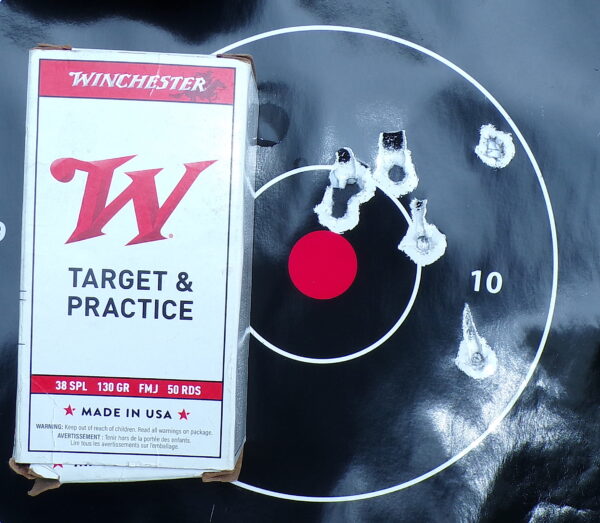

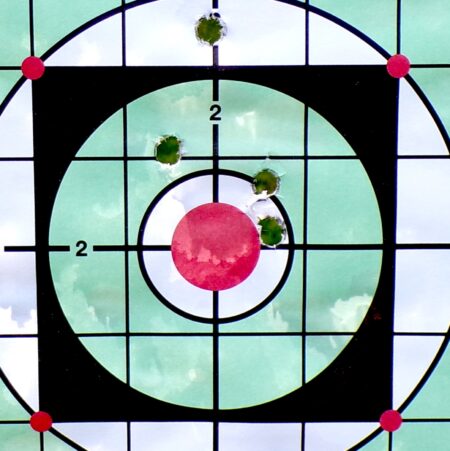
The .357s we tried all shot really close to the point of aim, a good thing. You want your “serious” ammo to be in the middle… if your practice ammo isn’t, that’s not the end of the world.
I could see carrying this guy on my hip as a backup during Indiana’s deer season. At the typical deer ranges we encounter, this .357 could even be primary armament, although I would use it in a secondary role.
That leads me to discuss usage.
Why Do You Need This Revolver?
A four-inch .357 Magnum revolver has many pluses going for it. It is not too large that you cannot carry it around your place as you go through your day. Stoke it with mild .38 Specials and you have a very decent small-game gun … just make sure you re-check your zero as .38s and .357s tend not to shoot to the same point of impact.
Another use is one I mentioned, as a backup to your main deer (or other critter) armament. A full-bore .357 load will do wonders to pacify almost anything you’d run across, as gun writer Philip Sharpe found out after the original .357 “Registered Magnum” was introduced along with the cartridge in 1935. He used it to take all kinds of game, across more than one continent, in his 8 3/8″ barreled .357.
Lastly, there’s always self- or home-defense. Again, the .357 is nothing to sneeze at… police agencies found out, in the days before semi-autos took over, that a 125-grain .357 bullet would do wonders against someone shooting back or their car’s windshield or door.
That was why the .357 was introduced in the first place. In 1935, when it came out, gangsters were getting away too often, as the cops had nothing that would punch through car doors or windshields. The .357 Magnum solved that problem.
Anyway, do you really need a reason to add another classic to your collection? I thought not.
Live Inventory Price Checker
| Smith & Wesson Model 19 Classic .357 Magnum Revolver 4.25″ 6rds, Blue | Palmetto State Armory | | |
| Smith & Wesson Model 19 Classic .357 Magnum Revolver – 12040 | Palmetto State Armory | | |
| Model 19 Classic K-Frame 357 Magnum Revolver – Model 19 Classic K-Frame 357 Mag 4.25″bbl 6rd Walnut No Lock | Brownells.com | | |
| Smith & Wesson 150544 442 No Internal Lock 38 Special 1.88 5 Round Black Black Synthetic Grip | Shooters Choice | |


Summing Up
For many shooters out there, especially younger ones, revolvers are some archaic tool that firearms anthropologists unearth from time to time, but those of us who are familiar with them know better. I own several, and have owned many over the 50 or so years I’ve been involved in the shooting sports.
I’ve killed many deer and smaller critters like squirrels with wheelguns and have had fun doing so over the decades. I also regularly carry snub-nosed versions, in either .38 Special or .357 Magnum. There’s a lot to be said for wheelguns, and there are very few with the backstory and cache of the classic Model 19. It is truly something that has earned a reputation over the years and isn’t about to stop now. If you are interested in learning more, check it out here.
About Mike Hardesty
With experience spanning over 45 years, Mike Hardesty has long enjoyed shooting and reloading. An inveterate reloader, he casts bullets and reloads for a diverse array of firearms, each handled with long-practiced precision. Living in rural Indiana, his homestead boasts a personal 100-yard range where he shares his love for guns to his four sons, their wives, and eleven grandchildren. As a recognized author, his writings have been featured in notable platforms like Sniper Country, Bear Creek Arsenal Blog, Pew Pew Tactical, TTAG, Dillon Precision’s Blue Press, and Gun Made, revealing his ongoing passion for firearms at the age of 72.
Read MoreAmmoLand Shooting Sports News