
Suppressed Home Defense – Is Silence Brass Colored?

The Big Beautiful Bill has been passed and signed, and it’s a massive bill. I won’t delve too deeply into it for this article, as most of its numerous pages and piles of deficit spending are irrelevant to the subject of suppressors. The portion that matters to us is the reduction of tax stamp fees from $200 to $0 for short-barreled rifles, suppressors, short-barreled shotguns, and AOWs. The NFA is still in place, and the registration and paperwork aspect still exist.

Off the bat, suppressors will sell like hot cakes. SBRs are easy to make and form 1, but suppressors are a different beast. I imagine many people will purchase suppressors in the coming years. With increased sales, we’ll see increased commonality. As such, the use of suppressors will explode for competition, range use, and even home defense.
It’s the latter we’ll be discussing. Today, we are going to see if silence is truly golden, or maybe it’s brass colored. Let’s dig into using suppressors for home defense and examine the pros and cons of a suppressed home defense weapon.
The Downsides of Using a Suppressor for Home Defense
Let’s rip off the Band-Aid and discuss the downsides to using suppressors for home defense.
They Aren’t Cheap
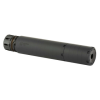
Good cans, especially those designed for centerfire weapons, are not cheap. Even a cheap suppressor for a rimfire rifle is a couple of hundred dollars. Suppressors might be the most expensive accessory you can slap on your weapon. Price varies a fair bit, but the Velos 556K sitting on the end of my Colt EPR doubles its cost.

With that said, at least the $200 tax stamp will be thrown into the trash. That will trim the cost of ownership a fair bit.
Regulation
While you don’t have to pay for the stamp, you still have to deal with the NFA and its regulations. The NFA can feel like wrestling a Balrog at times. Some states outright ban suppressors, even if you follow all federal laws and regulations. That’s an annoying obstacle that won’t be changed overnight.

You’ll still have to do the paperwork, submit fingerprints, alert your local CLEO, and send the ATF a selfie. It’s a hassle, and I imagine wait times will skyrocket once more when the tax stamp officially gets set to $0.
They Add Bulk
From a practical and tactical perspective, suppressors add bulk to a gun. They make it longer, which sucks for home defense and close-range use. Longer guns are tougher to maneuver indoors, and home defense is defined by the home.

That’s always a problem, but since short-barrel rifles will be tax-stamp-free, maybe it won’t be such a big deal after all. Suppressors add weight, and front-heavy guns can feel burdensome, especially if they have to be wielded with one hand. It’s a minor issue, but one you have to address when wielding suppressors.
Accessory Issues
Suppressors can clash with your accessories. On rifles, a suppressor can create a shadow in the middle of your weapon-mounted light. This can be mitigated with the right mounts and lights, but then we are spending even more money.

On handguns, we also deal with a shadow in the middle of the light, and some suppressors might make it difficult to mount a light and ensure reliable function. You don’t want the suppressor to touch the light, and with the wrong combo, that can happen.
Additionally, on handguns, you might need suppressor-height sights or a red dot. Again, more cost is added to the platform.
(Possible) Reliability Issues
Suppressors can do some funky stuff with guns. With rifles and shotguns, it can affect semi-automatic gas mechanisms and create additional back pressure. It’s rare that this causes issues, but it’s entirely possible.

Handguns are a different beast altogether. Most will work okay when you use a proper Nielsen device. Others don’t suppress well and can malfunction even with a Nielsen device. Like anything, you need to go to the range and shoot your combo of gun and suppressor to see if they work well together.
The Upsides Of A Home Defense Suppressor
Of course, it’s not all bad; there are tons of benefits to using a suppressor for home defense.
Reduces Noise
This is the big duh in the room. Guns are loud, very loud, and suppressors reduce that noise. They don’t eliminate that noise, but suppressors reduce it significantly. For you, that means hearing preservation. Your ears might still ring, especially with supersonic ammo, but some preservation is better than none.

Reducing noise also makes it easier to increase communication. If you’re talking to police on the phone, or simply telling a family member what to do, you can a bit easier without losing your hearing. Communication with police who may have just arrived on the scene is also crucial. Cutting noise makes a big difference.
Goodnight Muzzle Flash
Most suppressors are going to reduce and even eliminate muzzle flash. If you’re using a short-barreled rifle, especially a 5.56 short-barreled rifle, you will deal with muzzle flash. Muzzle flash isn’t always an issue, but if something goes bump in the dark, then it can be an issue. You don’t want excessive muzzle flash in the dark.

Excessive muzzle flash can create bright spots in your vision and reduce your situational awareness. Much like hearing, being able to see can be invaluable for home defense. Some flow-through suppressors won’t eliminate muzzle flash, but they can redirect it forward and prevent you from having a first-hand view of it.
Easier to Control
Suppressors are the ultimate muzzle device. They reduce noise, but also eliminate muzzle flash, and can decrease muzzle rise and recoil. Suppressors add weight to the end of the barrel, adding weight at the end helps prevent muzzle rise, which makes rapid-fire shots easier.

Suppressors are made up of a series of baffles, and those baffles act a bit like a muzzle brake. This reduces recoil and makes the gun more controllable. Suppressors do everything every other muzzle device can do, but they do it all at once.
Live Inventory Price Checker
| Dead Air Mojave 9MM Modular Suppressor | Rainier Arms | | |
| Dead Air Wolfman 9mm Modular Suppressor w/ KeyMicro QD Kit | Bereli | | |
| Lantac USA Dragon 9mm MPX Muzzle Brake / Dead Air Wolfman KeyMicro Suppressor Mount – 13.5x1mm LH | GunMag Warehouse | | |
| Dead Air Mojave 9MM Modular Suppressor – FDE | Rainier Arms | |



My Take?
You didn’t ask, but it’s the internet, so you’ll get my take. I like suppressors for home defense. I think they are convenient, and when you fight the right combination of suppressor and gun, you can have an effective firearm for home defense that won’t have you hollering “What?” in the near future.
I’m excited to see what the future holds for suppressors and to see what happens when that tax stamp cost hits $0.
CCW Range Bag Essentials: What You Need to Train With Your Carry Pistol
About Travis Pike
Travis Pike is a former Marine Machine Gunner, a lifelong firearms enthusiast, and now a regular guy who likes to shoot, write, and find ways to combine the two. He holds an NRA certification as a Basic Pistol Instructor and is the world’s Okayest firearm’s instructor.
Read MoreAmmoLand Shooting Sports News